
Students from West Nottinghamshire College are playing a key role in a pioneering national project designed to make space science more accessible to people with visual impairments.
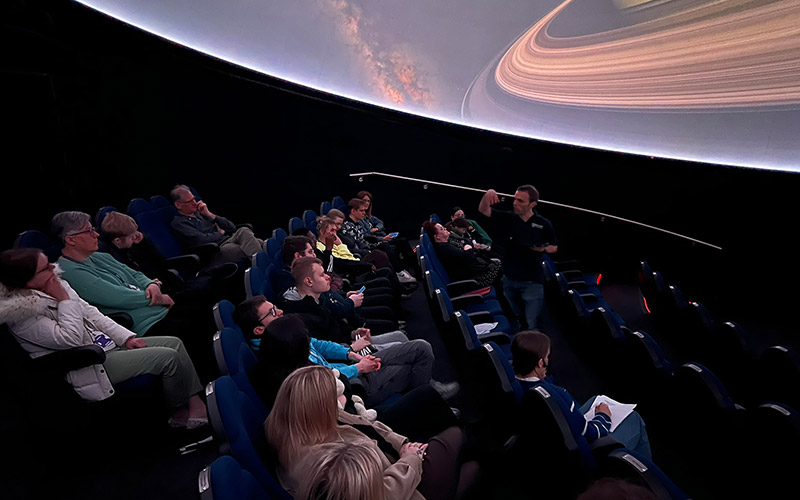
Students and staff hear from Dr Chris Harrison, reader in astrophysics at Newcastle University, who is leading the Audio Universe project.
A group of visually impaired learners recently visited Sherwood Observatory to take part in the latest phase of the Audio Universe project, led by Newcastle University.
Audio Universe is a research-led project that turns scientific data into sound and tactile experiences, opening up astronomy to a wider range of audiences. It includes multi-sensory resources such as an immersive planetarium show and tools that allow educators to create their own inclusive activities.
The initiative explores how astronomy – traditionally a highly visual subject – can be experienced through sound and touch, creating new ways for people of all abilities to engage with the wonders of the universe.
During the visit, current and former students with sight impairments tested the innovative audio-based resources inside the observatory’s 59-seat planetarium, providing direct feedback to researchers helping refine the next generation of shows.
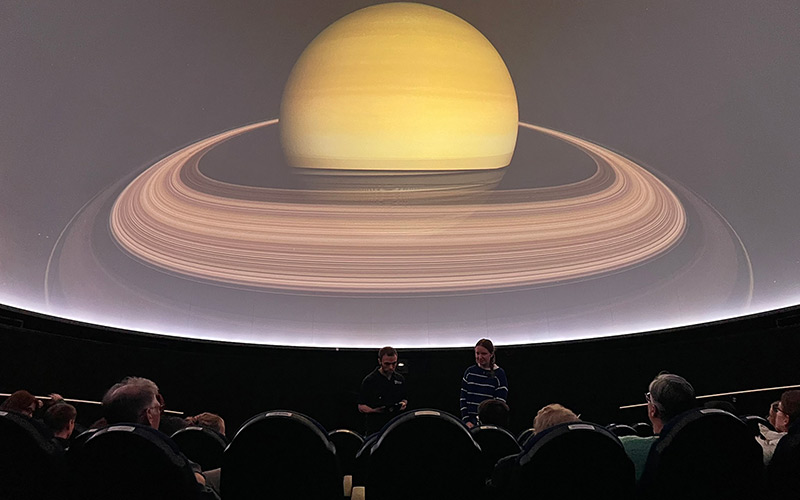
Dr Harrison and Rose Shepherd, a PhD student at Newcastle University studying sonification of astronomy data, helped students and staff explore the planets using sound and tactile models.
Dr Chris Harrison, reader in astrophysics at Newcastle University, who is leading the project, said: “Audio Universe is all about representing scientific data through sound and tactile models, alongside visuals.
“One of our major outputs so far has been a planetarium show about the solar system – now the next step is enabling planetariums to create their own shows using audio.
“By turning data about stars and planets into sound, we can open up astronomy in entirely new ways.
“Working with West Nottinghamshire College has been invaluable. This latest session was to test new resources and new ideas – things like how to represent constellations or star temperatures using audible cues – and getting direct feedback from the intended audience before we release these tools more widely.”
The project builds on earlier work involving the college’s visually impaired learners, who contributed to an initial research phase by evaluating different sounds through an online survey. The latest session marked a move to a more immersive, in-person experience.
Dr Harrison added: “What’s been really exciting is discovering that this isn’t just about accessibility. Many people say they can learn from both the sound and the visuals, so this enhances the experience for everyone.”
The collaboration was made possible through Sherwood Observatory, which has developed a strong partnership with the college and shares its commitment to inclusion.
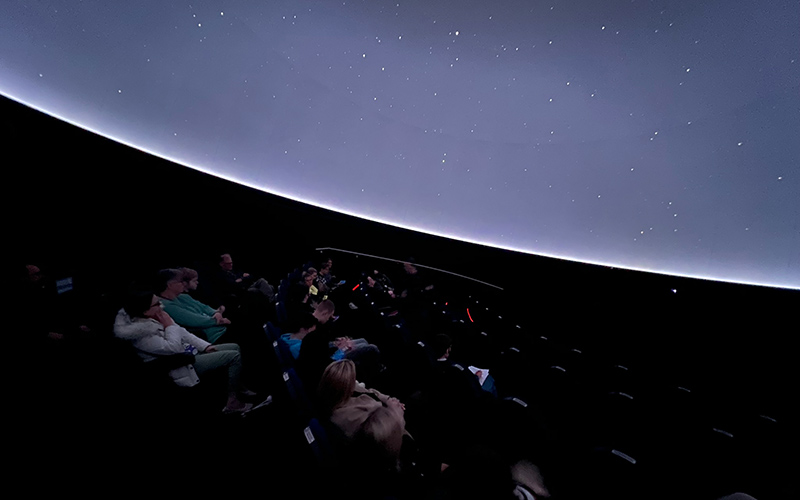
Those who took part in the visit learned how multi-sensory resources can help people with sight-impairments enjoy the wonders of the universe.
Dr Harrison continued: “The next phase is developing a ‘sonification suite’ app – software that will allow planetariums to generate sounds and tactile resources from data. We’ll also provide guidance on how to design shows for audiences with visual impairments and other additional needs.
“We’re currently in the testing phase, but we’re aiming to release both the app and a new show in the autumn.
“We’re working with around eight planetariums across the UK, and there’s growing interest worldwide through the International Planetarium Society, who have been talking to us about how we can make planetariums more accessible and this is a big part of that work.”
Dr Steve Wallace MBE, chair and science officer at Sherwood Observatory, said: “The reason we set up the observatory and planetarium was to include people who might otherwise miss out on these experiences, so we’re delighted to collaborate on this project.
“Planetarium content has traditionally been very visual, so bringing it to blind and visually impaired audiences is incredibly important.
“It’s a simple principle, really – why should anyone be excluded? We already adapt shows for people with hearing difficulties by including British Sign Language interpretation, so it makes complete sense to do the same for people with visual impairments.”
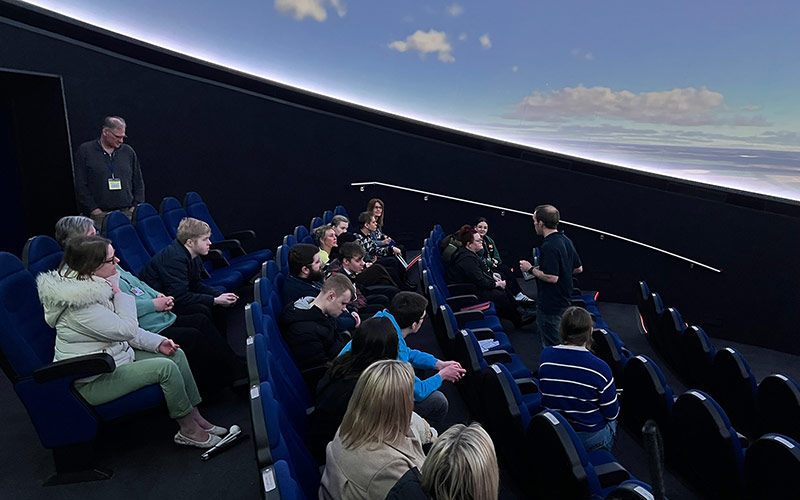
Dr Harrison and PhD student Rose Shepherd were keen to hear students’ views about the potential impact of the technology.
He added that involving learners directly in the research had been particularly valuable: “The students were actively saying what worked for them and what didn’t, and that makes them a genuine part of the research.”
Learners past and present who took part in the visit spoke positively about their experience and the potential impact of the technology.
Business student Bradley McKnight, who has been blind since birth due to the condition septo-optic dysplasia, said: “The audio elements were well integrated with the visuals – from what I could hear, they properly represented what sighted people were seeing. The tactile resources also gave a clear picture of what was going on.
“It’s the first time I’ve explored astronomy, so coming into it fresh has been really exciting. It’s great to see planetariums starting to translate visual experiences into audio for people like me who are totally blind.
“This kind of technology has value from two perspectives: it’s a great way to explore something new as a hobby but it could also inspire someone to pursue astronomy as a career.”
Former student, freelance musician and mixing engineer Marshall Fairbrother, who also has the same congenital condition as Bradley, highlighted the quality of the audio design: “The sounds were carefully chosen and matched really well with what was being shown on the dome. The tactile models were also very helpful. For example, when constellations were described as being in a certain position, I could feel that on the model and follow along.
“The way the sound was mapped to what was happening visually was excellent – it all made sense.
“Experiences like this are currently very hard to come by, so I think this will be hugely beneficial. The more people who can access and understand this kind of content, the better.”
With testing of the sonification suite continuing over the coming months, the project team hopes to launch the new toolkit and an updated planetarium show later this year, when Sherwood Observatory host the British Association of Planetaria annual conference, helping to ensure that the beauty and wonder of space can be shared by everyone.
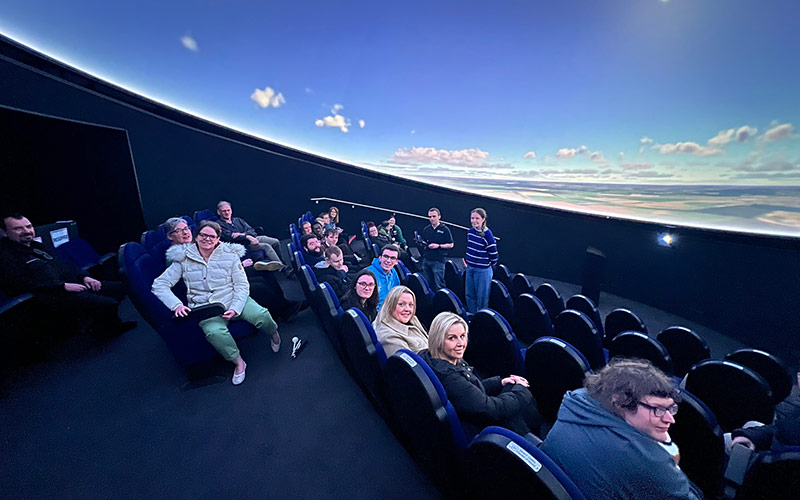
Students and staff took part in the research at Sherwood Observatory.
Rachel Fletcher, inclusion manager for vision impairment at the college, said: “This project is a fantastic example of inclusive practice in action. It gives our learners the opportunity to contribute to cutting-edge research while ensuring their voices directly influence how accessible experiences are designed.
“Our students’ feedback is helping to shape resources that could transform how people with visual impairments experience astronomy, not just locally but on a global scale. We are incredibly proud to be part of this partnership.”
Sherwood Observatory, on Coxmoor Road, Sutton-in-Ashfield, first opened in 1986 after being built by a team of volunteers from the Mansfield and Sutton Astronomical Society. It re-launched in November 2024 following a £6.8 million major expansion to create a state-of-the-art planetarium and science centre.
In November 2025, the Mansfield and Sutton Astronomical Society – who have operated the observatory since construction began in the 1970s – were awarded The King’s Award for Voluntary Service; the highest award a local voluntary group can receive in the UK and equivalent to an MBE.
To learn more about Audio Universe visit the official website www.audiouniverse.org or YouTube channel https://www.youtube.com/@audiouniverse8137.
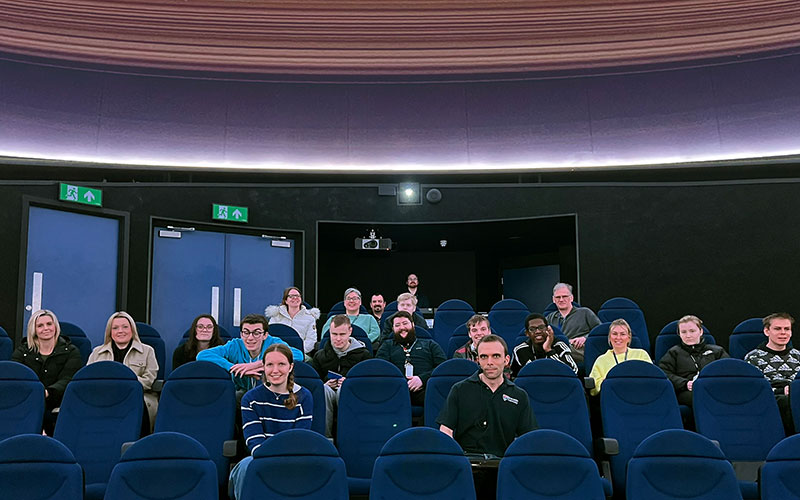
Visually-impaired students, college support workers, and staff from Sherwood Observatory joined Dr Harrison (front, right) and Rose Shepherd (front, left) in testing the resources.
The video below shows students experiencing a sonification of gravitational wave events during a live focus group at Sherwood Observatory.
Meanwhile, this video shows students taking part in an immersive audio experience of black holes merging:
Videos shown on the day included one of a black hole growing from a nearby star: