
Hairdressing and beauty therapy students had their turn at quizzing the experts last week during the curriculum’s employability week.
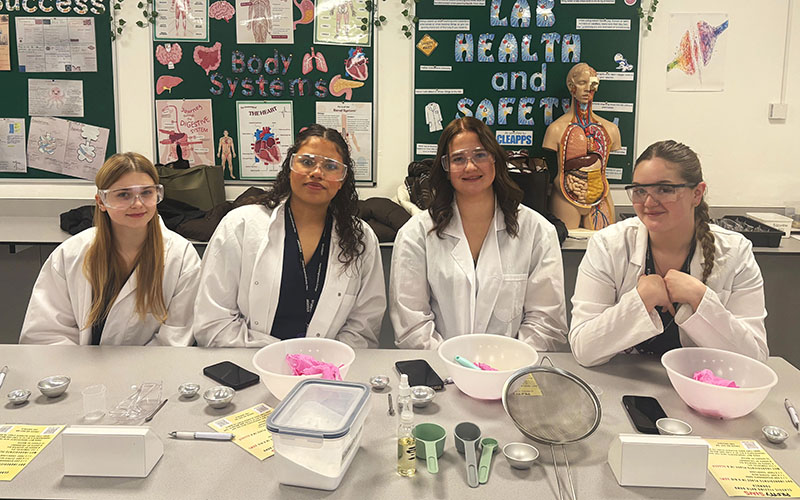
Beauty therapy students enjoyed creating a fizz in the lab.
The salons were buzzing with activity as guest speakers joined classes to share their journeys into successful careers as stylists, therapists and freelance artists, giving students valuable insight into the wide range of opportunities available within the hair and beauty industries.
One of the first activities to get students feeling creative was a Pretty Sins bath bomb making session held in the science lab. The Bolsover-based company, set-up by sisters Serene and Charlene Wright, has visited the department previously to deliver a lipstick-making class.
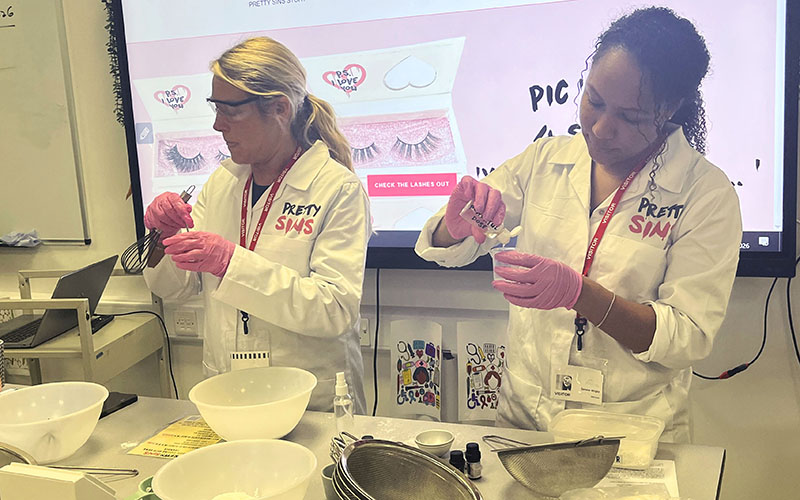
Kat and Serene from Pretty Sins demonstrated how to make the bath product.
This time, the fizz was being injected into the lesson as students learned how to accurately measure ingredients, select scents and colours, and create the perfect bath-time treat.
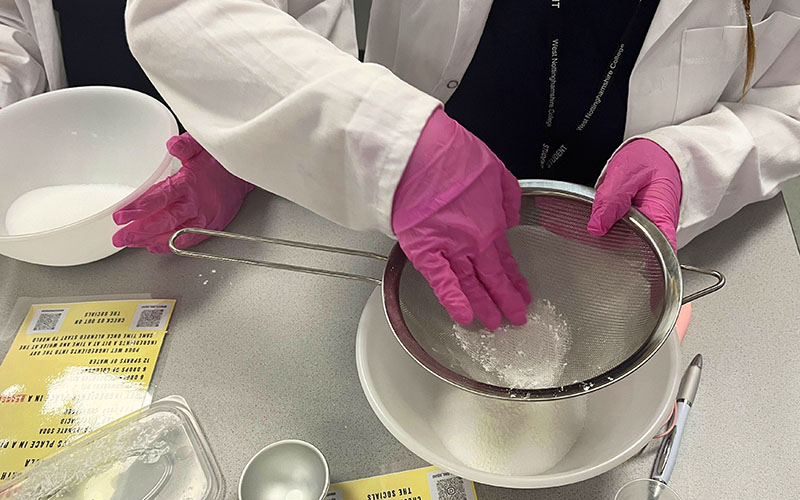
Careful measuring of the bath bomb ingredients.
Holistic therapies were also explored during the week. Beauty therapy teacher Kate Taylor demonstrated the ancient art of Hopi ear candling to Level 3 students, explaining how the practice is designed to promote relaxation and assist with clearing the sinuses and ear canal.
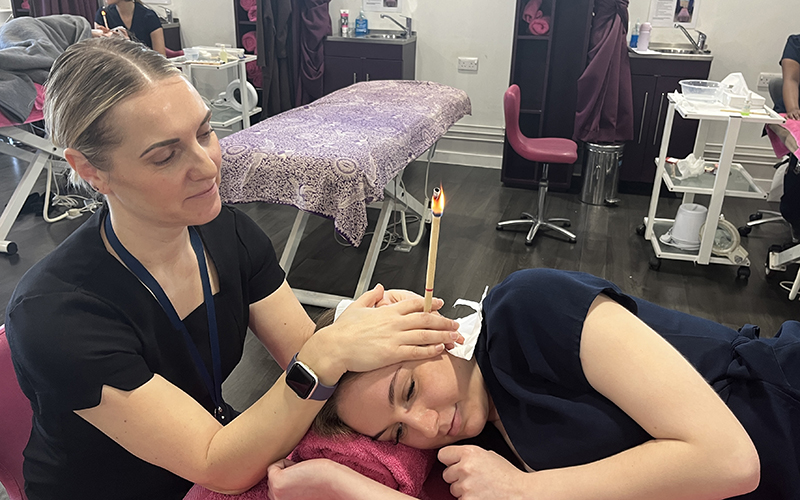
The ancient art of Hopi ear candling was practiced.
Meanwhile, other Level 3 learners enjoyed a talk and demonstration from Rebecca Howarth, of Sovereignty Healing Therapies, who shared her experiences of working as a Reiki Level 2 practitioner.
Reflexology was introduced through a guest session led by Melissa Hooks-Harris, a professional reflexologist, who spoke to students about careers within holistic therapy and demonstrated techniques commonly used in practice. Melissa shared her journey from working at Center Parcs’ Aqua Sana spa to launching her own home-based business, Mel-eficant, which operates from a log cabin and specialises in holistic and wellbeing treatments, inspiring students with her passion for the industry.
Make-up artistry students were treated to two specialist sessions focusing on working within television, stage and creative industries. Make-up artist Emma Fay brought her palette of colours and airbrush kit to demonstrate body art techniques.
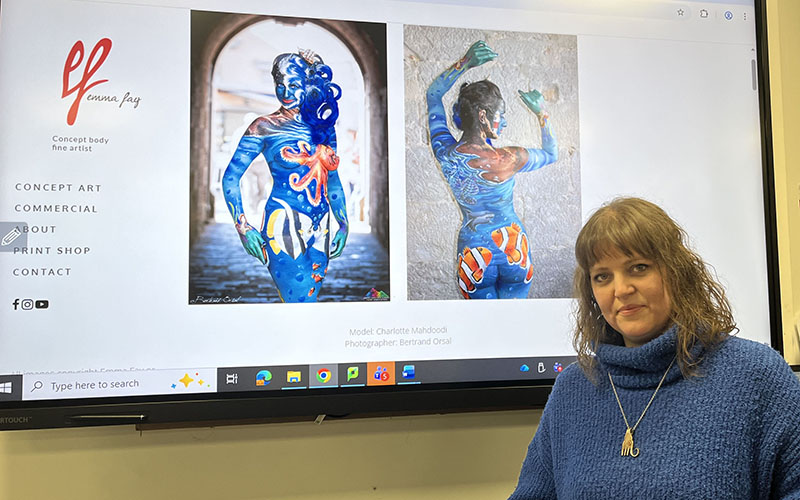
Make-up artist Emma Fay has worked with many top brands and individuals.
Emma specialises in large-scale body art, with her human-painted bodies documented through photography, film and live Marvels of Nature installations. Her career includes working with celebrities such as Joss Stone and Tom Daley, as well as projects for brands including Tiger Balm, Rowse’s Honey and the Olympic team.
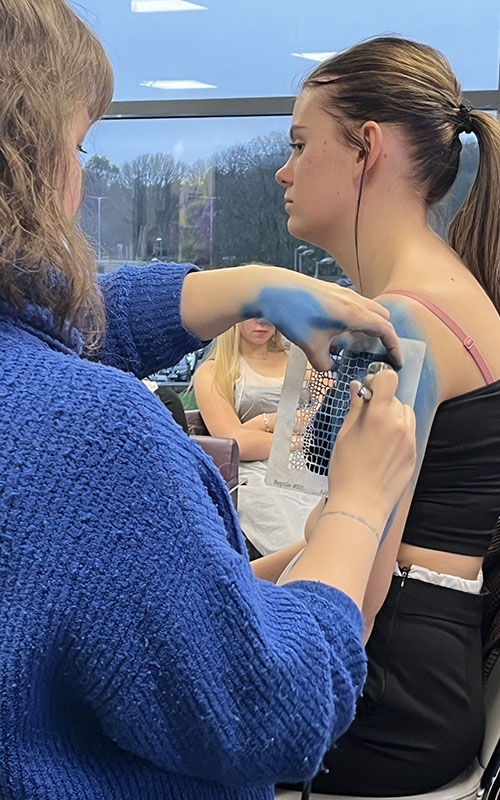
Emma and the students worked with airbrushing colours onto the skin.
College media teacher Steve Best also delivered a session drawing on his extensive experience in special effects make-up for film and television. As well as teaching acting for screen, Steve has worked on numerous industry projects creating prosthetics, realistic injuries and supplying props and make-up for stage and screen.
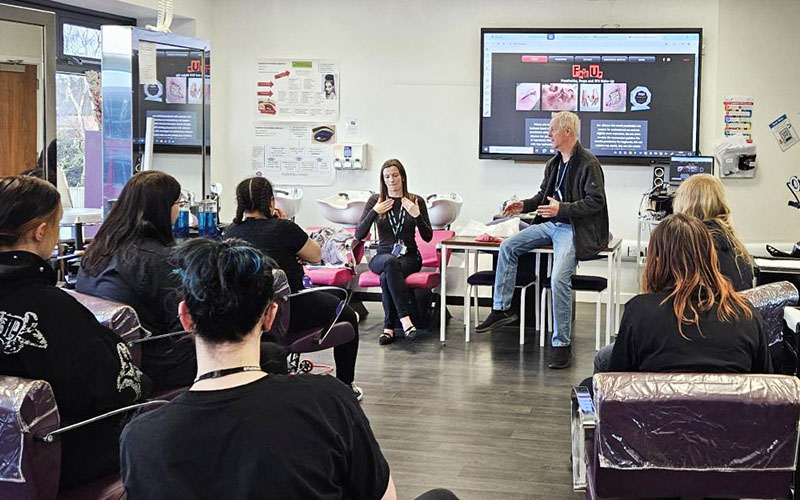
Media teacher and special effects expert Steve Best shared his knowledge and expertise on TV and stage.
During his session, students were introduced to the fundamentals of special effects make-up and saw first-hand how techniques are used to create believable characters and injuries for professional productions. He discussed how the students could eventually work in this sector and provided advice and guidance on working in the TV and film industry.
Steve spoke to the make-up artistry group’s learning company about an up-and-coming filming project in the college’s media class where they will have the chance to create make-up looks for the media students. This will be their first credit as make-up artists.
Things became rather hair-raising as trainee stylists developed new technical skills throughout the week. Make-up artistry students explored the art of preparing models for wig application and styling both real hair and synthetic wigs. Teacher Samantha Brown guided the hands-on session, which saw students experiment with a variety of alternative hairstyles and colours.
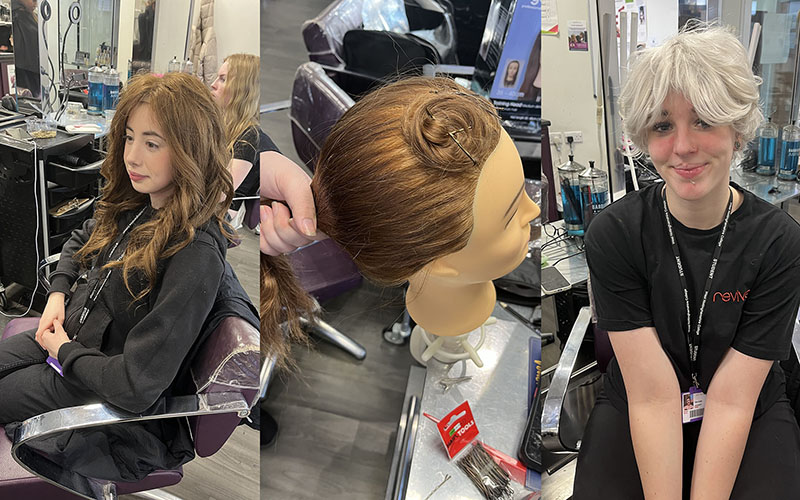
Make-up artistry students prepared and fitted wigs.
Balayage techniques were also practised by trainee hair stylists using mannequin heads. Balayage is a free-hand colouring technique where colour is painted onto the surface of the hair rather than fully saturated through foils, creating a soft, blended finish towards the tips.
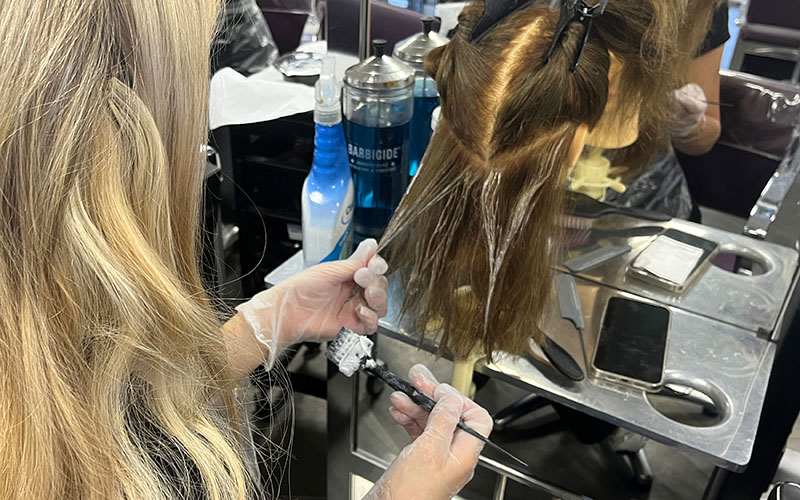
Careful application of colour to get the balayage look.
Former students also returned to inspire the next generation. Guest speaker Claire Guy, a former member of the hairdressing teaching staff, outlined her career journey from studying at West Notts to running her own salon, Clairabella’s, in Langwith. Owen Hannant, another former student, spoke about how hard work and determination have paid off, with Owen now one of seven former students operating as a self-employed stylist from the college’s Revive Studio Pro salon at the Derby Road campus.
Both hairdressing and beauty therapy students had the opportunity to discover a range of ‘add-on’ treatments that could enhance future client services. A hair-smoothing treatment was demonstrated by head of department Nicholas Thorpe, showing how a glossy, polished finish can be offered as part of a salon appointment. Beauty therapy students also learned effective lash and brow tinting techniques, demonstrated by Laura Wood of Ellisons’ product house.
Level 3 students were given a demonstration of dermaplaning, a minimally invasive procedure using a specialist implement to remove dead skin cells and fine facial hair, helping to reduce acne scarring and fine lines while leaving the skin smooth and rejuvenated.
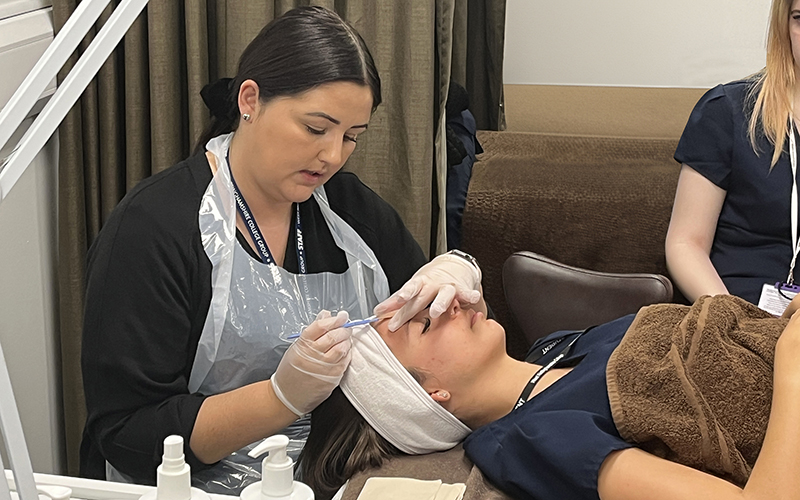
A great treatment to master - the art of dermaplaning.
Head of department Nicholas Thorpe said: “Employability week is always a highlight for us, and this year has been particularly inspiring. The range of guest speakers, treatments and creative sessions on offer has given our students a real sense of what is possible within the industry.
“Seeing professionals from so many different pathways share their experiences reinforces to our learners that there is no single route to success – just passion, skill and a willingness to keep learning.”